
Red Eye
A red eye occurs when blood vessels on or around the surface of the eye become enlarged, irritated, or inflamed. It may affect one eye or both eyes and can range from a small, painless red spot to widespread redness accompanied by pain, discharge, light sensitivity, or blurred vision.
Many cases are caused by dryness, allergies, irritation, or conjunctivitis. However, a red eye can sometimes be a sign of a more serious condition involving the cornea, inflammation inside the eye, an injury, or a sudden rise in eye pressure. An eye examination can determine the cause and the appropriate treatment.
Concerned about a red or irritated eye?
What Is a Red Eye?
Red eye is a general term used to describe redness involving the white portion of the eye, the tissues surrounding the eye, or the eyelids. The appearance develops when small blood vessels become more visible because of inflammation, irritation, infection, dryness, or injury.
Red eye is a symptom rather than a single diagnosis. The underlying cause may be minor and temporary, but the severity of the condition cannot always be determined by appearance alone.
Symptoms such as eye pain, light sensitivity, decreased vision, injury, or contact lens use can make a red eye more concerning and should be evaluated promptly.
What Does a Red Eye Look Like?
The appearance of a red eye can vary depending on its cause. You may notice:
- A pink or red color across the white of the eye
- Enlarged or more visible surface blood vessels
- Redness concentrated around the cornea
- A sharply defined bright-red patch
- Swollen or irritated eyelids
- Watery eyes
- Mucus or pus-like discharge
- Crusting along the eyelashes
- Redness affecting one eye or both eyes
A bright-red patch on the white of the eye may be a subconjunctival hemorrhage, while generalized redness with itching, discharge, pain, or blurred vision may have a different cause.
What Does Ptosis Look Like?
Ptosis can appear differently from person to person.
Common signs include:
- One upper eyelid sitting lower than the other
- Both upper eyelids appearing unusually low
- The eyelid partially covering the pupil
- Difficulty keeping the eyes completely open
- A tired or sleepy appearance
- Increased forehead wrinkles from constantly raising the eyebrows
Some patients gradually notice ptosis in photographs before realizing that their eyelid position has changed.
Common Symptoms That May Occur With Red Eye
Redness may occur by itself or with additional symptoms, including:
- Burning or stinging
- Itching
- A gritty or sandy sensation
- Excessive tearing
- Dryness
- Mucus or discharge
- Eyelid crusting
- Eyelid swelling
- A feeling that something is in the eye
- Contact lens discomfort
- Light sensitivity
- Eye pain
- Blurry or reduced vision
The combination of symptoms provides important clues about what may be causing the redness.
What Causes Red Eyes?
There are many possible causes of eye redness. Some are mild, while others require prompt treatment.
Dry Eye
Dry eye develops when the eyes do not produce enough tears or when the tears evaporate too quickly. An unstable tear film can cause redness, burning, fluctuating vision, watering, and a gritty sensation. Symptoms may become worse during computer use, in dry or windy environments, or after prolonged reading.
Allergies
Allergic conjunctivitis commonly causes redness in both eyes along with intense itching, watering, and eyelid swelling. Symptoms may be triggered by pollen, dust, mold, pet dander, or other allergens. Itching is often more prominent with allergies than with many other causes of red eye.
Conjunctivitis
Conjunctivitis, commonly called pink eye, is inflammation of the thin membrane covering the white of the eye and the inner eyelids. It may be caused by a virus, bacteria, allergies, or irritation. Viral and bacterial conjunctivitis can spread easily between people. Redness, watering, discharge, swelling, and crusting are common symptoms.
Blepharitis
Blepharitis causes inflammation along the eyelid margins. It may lead to red or swollen eyelids, crusting around the eyelashes, burning, irritation, and fluctuating vision. Blepharitis frequently occurs with meibomian gland dysfunction and dry eye.
Contact Lens Irritation or Infection
Contact lenses can cause redness when they are dry, damaged, contaminated, worn too long, or do not fit properly. Redness may also indicate inflammation or an infection of the cornea. Contact lens wearers should remove their lenses and contact an eye doctor promptly when redness occurs with pain, light sensitivity, discharge, or sudden blurry vision.
Foreign Body or Corneal Abrasion
Dust, sand, metal fragments, plant material, or another foreign object can irritate or scratch the cornea. Symptoms may include sudden redness, tearing, pain, light sensitivity, and the sensation that something is trapped in the eye. Do not attempt to remove an object that appears embedded in the eye.
Chemical Exposure
Household cleaners, workplace chemicals, cosmetics, sprays, and other substances can cause significant eye irritation or injury. After chemical exposure, immediately rinse the eye continuously with clean lukewarm water and seek emergency medical guidance. Do not delay rinsing while trying to identify the chemical.
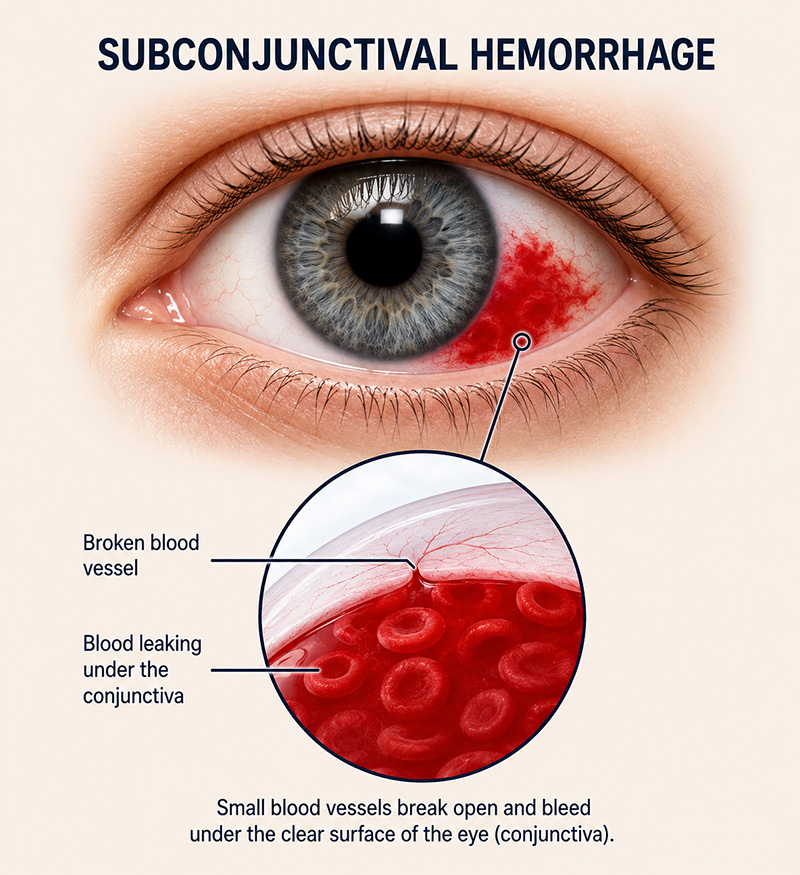
Subconjunctival Hemorrhage
A subconjunctival hemorrhage occurs when a tiny blood vessel breaks beneath the clear surface tissue covering the eye. It often appears as a sharply defined, bright-red patch.
Although the appearance can be dramatic, it is commonly painless and does not affect vision. It may occur spontaneously or after coughing, sneezing, straining, vomiting, or minor trauma. Recurrent episodes should be discussed with a healthcare provider.
Corneal Infection or Keratitis
Keratitis is inflammation or infection of the cornea. It may cause redness, pain, tearing, light sensitivity, discharge, and decreased vision. Corneal infections can progress quickly, especially in contact lens wearers, and may threaten vision without prompt treatment.
Uveitis
Uveitis is inflammation inside the eye. Symptoms may include redness, aching eye pain, light sensitivity, floaters, and blurred vision. Untreated inflammation may lead to vision loss or other complications.
Acute Angle-Closure Glaucoma
Acute angle-closure glaucoma occurs when pressure inside the eye rises suddenly. Symptoms may include severe eye pain, an intensely red eye, blurred vision, halos around lights, headache, nausea, or vomiting. This is an eye emergency that requires immediate treatment.
Eye Injury
Blunt trauma, scratches, penetrating injuries, burns, or high-speed debris can cause redness and damage to multiple parts of the eye. Any change in vision, severe pain, bleeding, irregular pupil shape, or suspected penetrating injury requires emergency care.
Is a Red Eye the Same as Pink Eye?
Not necessarily. “Pink eye” usually refers to conjunctivitis, which is one possible cause of eye redness. However, dry eye, allergies, blepharitis, contact lens complications, corneal infections, broken surface blood vessels, injuries, uveitis, and glaucoma can also make the eye appear red. Because several eye conditions can look similar without magnified examination, it is best not to assume that every red eye is contagious conjunctivitis.
When Is a Red Eye an Emergency?
Seek urgent eye care or emergency medical attention when redness occurs with:
- Moderate or severe eye pain
- Sudden or significant blurry vision
- Loss of vision
- Strong sensitivity to light
- Severe headache, nausea, or vomiting
- Halos around lights
- A chemical splash
- A penetrating or high-speed eye injury
- An object embedded in the eye
- An irregular or unusually shaped pupil
- Marked swelling around the eye
- Difficulty moving the eye
- Fever with significant eyelid swelling
- Recent eye surgery or an eye injection
- Rapidly worsening symptoms
Eye pain, light sensitivity, reduced vision, and intense redness are warning signs that should not be managed solely with over-the-counter drops.
Red Eye in a Contact Lens Wearer
Contact lens wearers should take unexplained redness seriously, particularly when it is accompanied by pain, discharge, light sensitivity, or blurred vision. Remove the contact lenses immediately and do not put them back in until an eye doctor says it is safe. Bring the lenses, case, and solution to the appointment when possible.
Red Eye After Surgery or an Injection
Increasing redness or pain after eye surgery or an eye injection may indicate infection or another complication. Contact the treating eye surgeon immediately, particularly if the redness is accompanied by worsening vision, discharge, swelling, or increasing pain.
How Is the Cause of Red Eye Diagnosed?
Your eye doctor will ask when the redness began, whether one or both eyes are affected, and whether you have pain, itching, discharge, light sensitivity, trauma, illness, or changes in vision.
The evaluation may include:
Visual Acuity Testing
Your vision is measured to determine whether the redness is associated with reduced or altered vision.
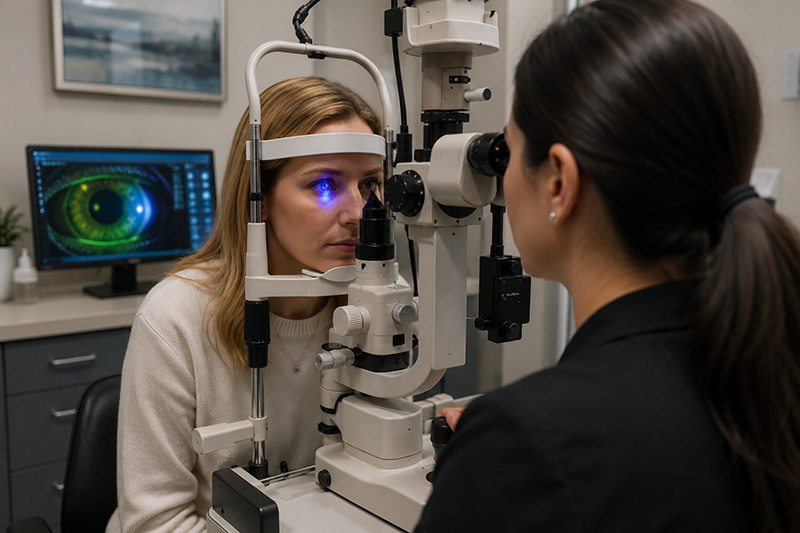
Slit-Lamp Examination
A slit lamp provides a magnified view of the eyelids, conjunctiva, cornea, tear film, and structures inside the front of the eye.
Fluorescein Dye Testing
A temporary diagnostic dye may be placed in the eye to reveal corneal scratches, foreign bodies, dryness, or areas of infection.
Eye Pressure Measurement
Eye pressure may be measured when glaucoma or inflammation is suspected.
Eyelid and Tear-Film Evaluation
The eyelids, eyelashes, oil glands, and tear quality may be examined for blepharitis, meibomian gland dysfunction, or dry eye.
Dilated Eye Examination
Dilation may be recommended when symptoms suggest inflammation or another condition involving deeper structures of the eye.
Additional testing may be performed depending on the findings.
How Is Red Eye Treated?
Treatment depends entirely on the underlying cause. There is no single eye drop that is appropriate for every red eye.
Possible treatments may include:
- Preservative-free artificial tears
- Cold or warm compresses
- Allergy eye drops
- Prescription anti-inflammatory medication
- Antibiotic medication for certain bacterial infections
- Antiviral or antifungal medication when appropriate
- Eyelid hygiene or treatment for blepharitis
- Dry eye therapy
- Removal of a foreign body
- Treatment of a corneal abrasion
- Discontinuation or refitting of contact lenses
- Pressure-lowering medication for glaucoma
- Urgent treatment for inflammation, infection, or injury
Antibiotics do not treat viral conjunctivitis, allergies, dry eye, or most other nonbacterial causes of redness. An accurate diagnosis helps avoid unnecessary or ineffective treatment.
Should I Use Redness-Relief Eye Drops?
Some over-the-counter redness-relief drops temporarily shrink surface blood vessels, making the eye appear whiter without treating the underlying condition. Frequent use can sometimes result in recurrent or rebound redness after the medication wears off.
Lubricating artificial tears may be more appropriate for minor dryness or irritation, but persistent, painful, recurrent, or unexplained redness should be evaluated rather than repeatedly concealed with whitening drops. The American Academy of Ophthalmology recommends medical evaluation when redness is sudden, persistent, painful, or associated with blurred vision.
Do not use leftover prescription eye drops or another person’s medication. Steroid eye drops should only be used under the supervision of an eye doctor because they can worsen certain infections and raise eye pressure.
What Can I Do at Home for a Mild Red Eye?
For mild irritation without pain, injury, discharge, light sensitivity, or vision changes, you may try:
- Removing contact lenses
- Avoiding eye makeup temporarily
- Applying a clean cool compress
- Using preservative-free artificial tears
- Taking breaks from digital screens
- Avoiding smoke, fans, and other irritants
- Washing your hands before touching the area
- Avoiding rubbing the eyes
Contact an eye doctor if symptoms worsen, persist, repeatedly return, or are accompanied by warning signs.
How Can I Avoid Spreading an Eye Infection?
When infectious conjunctivitis is suspected:
- Wash your hands frequently
- Avoid touching or rubbing your eyes
- Do not share towels, pillowcases, cosmetics, or eye drops
- Wash pillowcases and towels regularly
- Discard contaminated eye makeup
- Stop wearing contact lenses
- Clean commonly touched surfaces
- Follow your eye doctor’s instructions about returning to school or work
Viral and bacterial conjunctivitis can be contagious, while allergic conjunctivitis and dry eye are not.
Red Eye in Children
Children commonly develop red eyes from viral illnesses, bacterial conjunctivitis, allergies, blocked tear ducts, irritation, or foreign material in the eye.
Arrange an eye examination when a child has:
- Eye pain
- Light sensitivity
- Difficulty opening the eye
- Blurry or reduced vision
- Significant eyelid swelling
- Thick discharge
- A suspected injury
- Symptoms that worsen or do not improve
- Redness while wearing contact lenses
A red or draining eye in a newborn should be evaluated promptly because some causes require immediate treatment.
When Should I Schedule an Eye Examination?
Schedule an evaluation when:
- The redness persists or repeatedly returns
- You are unsure what is causing it
- Only one eye remains persistently red
- There is discharge or eyelid crusting
- Symptoms interfere with contact lens wear
- Over-the-counter treatments are not helping
- You recently started a new eye medication
- The redness occurs with discomfort or altered vision
Even mild-looking redness may require prompt attention when it occurs in a contact lens wearer or after eye surgery.
Frequently Asked Questions About Red Eye
What is the most common cause of red eyes?
Common causes include dry eye, allergies, irritation, conjunctivitis, blepharitis, and contact lens problems. An examination may be needed because several conditions can produce a similar appearance.
How can I tell whether my red eye is serious?
Pain, light sensitivity, blurred or decreased vision, injury, nausea, severe headache, marked swelling, and contact lens use are important warning signs. Seek prompt care when any of these symptoms are present.
Can dry eye make my eyes look red?
Yes. An unstable or inadequate tear film can irritate the surface of the eye, making blood vessels more visible. Dry eye may also cause burning, watering, fluctuating vision, and a gritty sensation.
Does a red eye always mean conjunctivitis?
No. Conjunctivitis is only one possible cause. Redness can also result from allergies, dry eye, blepharitis, contact lens complications, corneal disease, inflammation, glaucoma, injury, or a broken blood vessel.
Is every red eye contagious?
No. Viral and bacterial conjunctivitis may be contagious. Redness caused by allergies, dry eye, subconjunctival hemorrhage, blepharitis, injury, glaucoma, or uveitis is not spread from person to person.
Why is only one of my eyes red?
One-sided redness may be caused by a foreign body, abrasion, infection, blocked oil gland, contact lens problem, inflammation, injury, or subconjunctival hemorrhage. Persistent unilateral redness should be examined.
Why are both of my eyes red?
Redness in both eyes commonly occurs with allergies, dry eye, viral conjunctivitis, environmental irritation, or blepharitis. Symptoms and examination findings help identify the cause.
Why is my eye red but not painful?
Painless redness may occur with mild dryness, irritation, allergies, conjunctivitis, or a subconjunctival hemorrhage. Seek care if the redness is intense, persistent, recurrent, or accompanied by discharge or vision changes.
What causes a bright-red spot on the white of the eye?
A sharply defined red patch is often caused by a subconjunctival hemorrhage, which is a small amount of blood trapped beneath the clear surface tissue. It usually does not cause pain or affect vision, but recurrent episodes should be evaluated.
Can lack of sleep cause red eyes?
Fatigue may contribute to dryness and make surface blood vessels more noticeable. Persistent redness should not automatically be attributed to lack of sleep.
Can screen use cause red eyes?
Extended screen use can reduce blinking and contribute to tear evaporation, dryness, irritation, and redness. Regular visual breaks and treatment of underlying dry eye may help.
Can contact lenses cause red eyes?
Yes. Contact lenses may cause dryness, poor oxygen transmission, mechanical irritation, inflammation, an allergic response, or infection. Remove your lenses and call an eye doctor if redness is accompanied by pain, light sensitivity, discharge, or blurred vision.
Should I stop wearing my contact lenses if my eye is red?
Yes. Remove the lenses and do not resume wear until the redness has resolved and an eye doctor has determined that it is safe, particularly when the cause is unclear.
Do I need antibiotic drops for a red eye?
Not always. Antibiotics only treat certain bacterial infections. They do not treat viral infections, allergies, dry eye, or inflammation from many other causes.
Can I use old prescription eye drops?
No. Leftover medication may be expired, contaminated, or inappropriate for the current condition. Certain drops, including steroids, can make some infections worse.
How long does a red eye last?
The duration depends on the cause. Mild irritation may improve quickly, while dry eye, allergies, infection, blepharitis, or inflammation may continue until the underlying condition is treated.
When should I go to the emergency room for a red eye?
Seek emergency care for severe pain, sudden vision loss, chemical exposure, penetrating injury, an irregular pupil, intense headache with nausea, or rapidly worsening symptoms. Sudden red eye with severe pain and blurred vision may indicate acute angle-closure glaucoma.
Patient Testimonials
Schedule an Evaluation for Red or Irritated Eyes
A red eye may be caused by a minor surface irritation, but appearance alone cannot reliably rule out infection, corneal disease, inflammation, injury, or elevated eye pressure.
The doctors at NH Eye Associates can examine the eye, identify the source of the redness, and recommend treatment based on the underlying cause. Do not delay care when redness is accompanied by pain, light sensitivity, reduced vision, injury, or contact lens wear.