
Distorted Vision
Why Straight Lines Look Wavy or Objects Look Warped
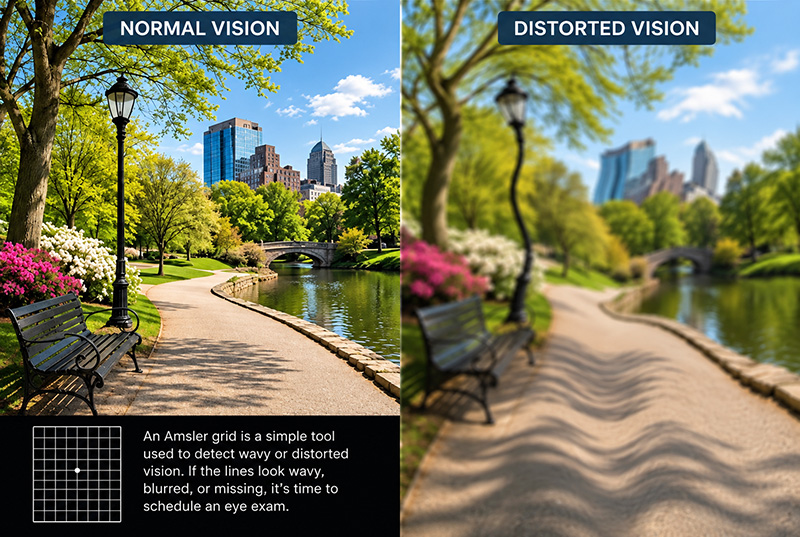
Distorted vision means that objects do not appear in their normal shape. Straight lines may look wavy, door frames may appear bent, faces may look warped, or part of your vision may seem stretched, shrunken, rippled, or missing.
Distorted vision can occur in one eye or both eyes. It may develop gradually or happen suddenly. Because distortion often involves the retina or macula — the part of the eye responsible for sharp central vision — it should be evaluated by an eye doctor, especially if it is new or worsening.
What Does Distorted Vision Look Like?
Patients often describe distorted vision as:
- Straight lines looking wavy
- Words on a page appearing bent or uneven
- Faces looking warped
- Door frames or blinds appearing curved
- A grid pattern looking crooked
- Objects appearing smaller or larger than normal
- A blurry or missing spot in the center of vision
- Vision that looks rippled, stretched, or twisted
- Trouble reading even with glasses
A common search phrase is: “Why do straight lines look wavy?” This symptom can be an important warning sign of macular disease.
Common Causes of Distorted Vision
Macular Degeneration
Age-related macular degeneration affects the central retina and can cause wavy, distorted, or missing central vision. Wet macular degeneration can cause sudden distortion and requires prompt evaluation.
Macular Pucker
A macular pucker occurs when a thin layer of scar tissue forms on the surface of the macula. This can wrinkle the retina and make straight lines appear wavy or bent.
Macular Hole
A macular hole is a small opening in the central retina. It can cause central blur, distortion, missing spots, or difficulty reading.
Diabetic Macular Edema
Diabetes can cause fluid to build up in the macula, leading to blurred or distorted central vision. Many patients with diabetes may develop retinal changes before noticing symptoms.
Retinal Vein Occlusion
A blocked retinal vein can cause bleeding and swelling in the retina. This may lead to blurry, distorted, or decreased vision in one eye.
Retinal Tear or Retinal Detachment
Retinal tears or detachments may cause flashes, floaters, shadows, decreased vision, or distortion. A curtain-like shadow or sudden change in vision requires urgent evaluation.
Epiretinal Membrane
An epiretinal membrane is another term often used for macular pucker. It can pull on the retina and distort central vision.
When Is Distorted Vision an Emergency?
Seek urgent eye care if distorted vision is sudden, worsening, or associated with:
- New flashes of light
- New floaters
- A curtain or shadow in vision
- Sudden central vision loss
- Eye pain
- New double vision
- Vision loss in one eye
- A sudden dark or missing spot
- Recent eye injury
Sudden distortion may be a sign of wet macular degeneration, retinal detachment, retinal bleeding, or another serious eye condition.
How Is Distorted Vision Diagnosed?
A comprehensive eye exam may include:
- Visual acuity testing
- Refraction
- Dilated retinal examination
- Amsler grid testing
- Optical Coherence Tomography, or OCT
- Retinal photography
- Widefield retinal imaging
- Fluorescein angiography when needed
- Corneal topography if the cornea may be involved
OCT imaging is especially helpful because it allows your doctor to see detailed cross-sectional images of the macula.
Treatment for Distorted Vision
Treatment depends on the cause. For wet macular degeneration, diabetic macular edema, or retinal vein occlusion, treatment may include eye injections to reduce leakage and swelling. For macular pucker or macular hole, surgery may be recommended if distortion significantly affects reading, driving, or daily activities.
For corneal causes, treatment may include updated glasses, specialty contact lenses, dry eye treatment, or corneal evaluation. For cataracts or prescription changes, clearer vision may be improved with glasses or cataract surgery, but true distortion usually requires careful retinal evaluation.
Can Distorted Vision Be Tested at Home?
An Amsler grid can help detect central vision distortion. When looking at the center dot, the lines should appear straight and evenly spaced. If lines appear wavy, bent, missing, or blurred, schedule an eye exam promptly. Home testing does not replace a dilated eye exam or OCT imaging.
Can Blurry Vision Come and Go?
Yes. Intermittent blurry vision is often caused by:
- Dry eyes
- Eye fatigue
- Blood sugar fluctuations
- Contact lens problems
- Migraines
- Changes in focusing ability
However, recurring episodes should still be evaluated by an eye doctor.
Can Stress Cause Blurry Vision?
Stress itself usually does not damage the eyes, but it can contribute to:
- Eye strain
- Dry eyes
- Migraine-related visual symptoms
- Temporary focusing problems
Persistent blurry vision should never be assumed to be caused solely by stress.
Can Screen Time Cause Blurry Vision?
Extended computer use may lead to digital eye strain, causing:
- Temporary blurry vision
- Dry eyes
- Difficulty refocusing
- Eye fatigue
- Headaches
The 20-20-20 rule and regular blinking can help reduce symptoms.
What Should I Do If My Vision Suddenly Becomes Blurry?
If your vision suddenly becomes blurry, especially in one eye or if it is associated with pain, flashes, floaters, weakness, or other neurological symptoms, seek emergency medical care immediately. If the change is gradual and painless, schedule a comprehensive eye examination as soon as possible.
Frequently Asked Questions
Why do straight lines look wavy?
Straight lines may look wavy when the macula is affected by swelling, pulling, bleeding, or degeneration. Common causes include macular degeneration, macular pucker, macular hole, diabetic macular edema, and retinal vein occlusion.
Is distorted vision serious?
Distorted vision can be serious, especially if it is new, sudden, or only in one eye. It may be a sign of retinal or macular disease and should be evaluated by an eye doctor.
Can dry eye cause distorted vision?
Dry eye usually causes fluctuating blurry vision, but an unstable tear film can sometimes make vision seem smeared or irregular. Persistent wavy lines or warped images should be checked for retinal causes.
What causes distorted vision in one eye?
Distortion in one eye is often caused by a problem in that eye, such as macular degeneration, macular pucker, macular hole, diabetic swelling, retinal vein occlusion, corneal irregularity, or retinal disease.
Can distorted vision go away?
Some causes improve with treatment, while others may persist or worsen without care. Early diagnosis gives the best chance of protecting vision.
Should I see an eye doctor for wavy vision?
Yes. New wavy vision should be evaluated, especially if it affects one eye, reading, faces, or central vision.
What test shows why my vision is distorted?
OCT imaging is one of the most useful tests for distorted vision because it shows detailed images of the macula and can detect swelling, pulling, holes, or degeneration.
Patient Testimonials
Straight Lines Should Not Look Wavy
If your vision looks warped, rippled, bent, or distorted, do not ignore it. Distorted vision may be an early sign of a retinal or macular condition that needs prompt diagnosis. Schedule a comprehensive eye exam with NH Eye Associates today to determine the cause of your distorted vision and protect your sight.