
Double Vision
Why Am I Seeing Two Images?
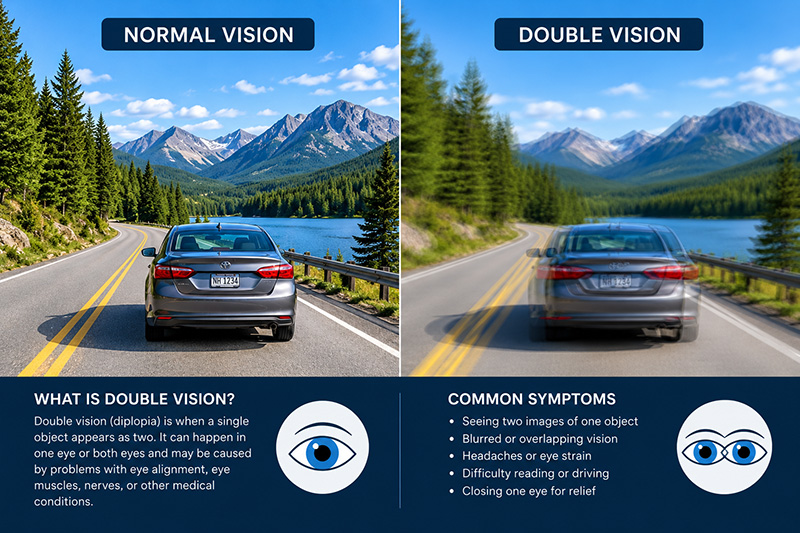
Double vision, also called diplopia, occurs when one object appears as two. The images may appear side by side, on top of each other, diagonal, overlapping, or slightly shadowed. Double vision may affect one eye or both eyes and can develop suddenly or gradually.
Because double vision can be caused by eye alignment problems, eye muscle issues, nerve problems, cataracts, corneal disease, thyroid eye disease, stroke, or other medical conditions, new double vision should be evaluated promptly.
What Does Double Vision Look Like?
Patients may describe double vision as:
- Seeing two images of one object
- Images appearing side by side
- Images appearing vertically stacked
- Images appearing diagonal or tilted
- Words overlapping while reading
- Trouble driving because lane lines or cars appear doubled
- Closing one eye to see clearly
- Eye strain or headaches from trying to focus
- Double vision that comes and goes
- Double vision worse in certain directions of gaze
Monocular vs. Binocular Double Vision
Monocular Double Vision
Monocular double vision remains present when one eye is covered. It is usually caused by a problem within one eye rather than eye alignment.
Common causes include:
- Cataracts
- Dry eye disease
- Corneal irregularity
- Keratoconus
- Astigmatism
- Lens implant issues
- Retinal distortion
Binocular Double Vision
Binocular double vision goes away when either eye is covered. This usually means the eyes are not working together properly.
Common causes include:
- Eye muscle imbalance
- Cranial nerve palsy
- Thyroid eye disease
- Stroke or neurologic disease
- Myasthenia gravis
- Trauma
- Decompensated childhood eye misalignment
- Orbital disease
This distinction is very important and helps guide diagnosis.
Common Causes of Double Vision
Eye Muscle or Eye Alignment Problems
The eyes must point at the same object at the same time. If one eye turns inward, outward, upward, or downward, the brain may receive two separate images.
Cranial Nerve Palsy
Several nerves control eye movement. If one of these nerves is affected by diabetes, high blood pressure, inflammation, trauma, aneurysm, or other neurologic conditions, double vision can occur.
Thyroid Eye Disease
Thyroid eye disease can cause inflammation and swelling around the eye muscles. This may restrict eye movement and cause double vision, bulging eyes, eyelid changes, pressure, or eye discomfort.
Cataracts
Cataracts can sometimes cause ghosting or double vision in one eye, especially when looking at lights or high-contrast objects.
Dry Eye Disease
An unstable tear film can cause ghosting, shadowing, fluctuating blur, or double-like images, especially during reading, screen use, or driving at night.
Corneal Problems
Keratoconus, corneal scarring, irregular astigmatism, prior eye surgery, or contact lens problems can create distorted or doubled images.
Stroke or Neurologic Conditions
Sudden double vision can sometimes be a warning sign of a stroke or neurologic emergency, especially if it occurs with weakness, numbness, dizziness, facial drooping, trouble speaking, or difficulty walking.
Migraine
Some migraines can cause temporary visual symptoms. However, new double vision should not be assumed to be migraine without proper evaluation.
Myasthenia Gravis
Myasthenia gravis can cause fluctuating double vision and droopy eyelids. Symptoms may worsen later in the day or with fatigue.
When Is Double Vision an Emergency?
Seek urgent medical care if double vision is sudden or occurs with:
- Weakness or numbness
- Facial drooping
- Trouble speaking
- Severe headache
- Dizziness or loss of balance
- New droopy eyelid
- Eye pain
- Recent head or eye injury
- Unequal pupils
- Sudden vision loss
- Difficulty swallowing or breathing
Sudden binocular double vision should be taken seriously, especially in adults.
How Is Double Vision Diagnosed?
A double vision evaluation may include:
- Visual acuity testing
- Refraction
- Eye alignment testing
- Eye movement testing
- Pupil examination
- Slit lamp examination
- Dilated eye examination
- Eye pressure measurement
- Neurologic screening
- OCT or retinal imaging when needed
- Visual field testing when appropriate
- Bloodwork or imaging referral when indicated
Your eye doctor will first determine whether the double vision is monocular or binocular, then look for the underlying cause.
Treatment for Double Vision
Treatment depends on the cause.
Options may include:
Updated Glasses or Contact Lenses
If double vision is related to astigmatism, corneal irregularity, cataract changes, or prescription problems, updated lenses may help.
Prism Glasses
Prism can help align images so the brain sees one image instead of two. Prism may be temporary or permanent depending on the cause.
Dry Eye Treatment
If tear film instability is causing ghosting or shadowing, treatment may include artificial tears, prescription drops, lid care, warm compresses, LipiFlow, IPL, or other dry eye therapies.
Cataract Surgery
If cataracts are causing monocular double vision or significant ghosting, cataract surgery may improve visual clarity.
Treatment of Underlying Medical Conditions
Double vision caused by thyroid eye disease, diabetes, high blood pressure, inflammation, neurologic disease, or myasthenia gravis may require coordinated care with other specialists.
Eye Muscle Surgery
For some persistent alignment problems, eye muscle surgery may be considered.
Can Double Vision Come and Go?
Yes. Intermittent double vision can occur with:
- Eye muscle fatigue
- Decompensated eye alignment problems
- Dry eye
- Contact lens issues
- Myasthenia gravis
- Thyroid eye disease
- Migraine
- Blood sugar fluctuations
Even if double vision comes and goes, it should be evaluated if it is new, worsening, or affecting daily activities.
Frequently Asked Questions
Why am I seeing double?
Double vision may be caused by eye alignment problems, cataracts, dry eye, corneal disease, thyroid eye disease, nerve problems, stroke, trauma, or neurologic conditions.
How do I know if double vision is serious?
Double vision is more concerning if it starts suddenly, goes away when either eye is covered, or occurs with headache, weakness, numbness, dizziness, droopy eyelid, unequal pupils, or trouble speaking.
What is the difference between ghosting and double vision?
Ghosting often looks like a faint shadow around letters or lights and may be related to dry eye, astigmatism, cataracts, or corneal issues. True double vision usually means two separate images are seen.
Why does double vision go away when I cover one eye?
If double vision disappears when either eye is covered, it is usually binocular double vision, meaning the eyes are not properly aligned.
Can dry eye cause double vision?
Dry eye can cause ghosting, shadowing, and fluctuating blur that may feel like double vision. True binocular double vision usually comes from eye alignment or nerve-related causes.
Can cataracts cause double vision?
Yes. Cataracts can cause monocular double vision, glare, halos, or ghosting in one eye.
Can double vision be caused by a stroke?
Yes. Sudden double vision can be a stroke symptom, especially if it occurs with weakness, numbness, facial drooping, dizziness, trouble walking, or difficulty speaking.
What doctor should I see for double vision?
An eye doctor can determine whether the double vision is coming from the eye itself, eye alignment, eye muscles, nerves, or a medical condition. Some patients may need referral to a neuro-ophthalmologist or other specialist.
Will double vision go away?
Some causes improve with treatment or time, while others require glasses with prism, medical treatment, surgery, or neurologic evaluation. The cause must be identified first.
Patient Testimonials
Seeing Double? Do Not Ignore It.
Double vision can be caused by something simple, but it can also be a warning sign of a serious eye or neurologic condition. A comprehensive eye exam can help determine whether your double vision is coming from the eye, eye muscles, nerves, or another medical issue.
Schedule an eye evaluation with NH Eye Associates today for a careful diagnosis and personalized treatment plan.