
Difficulty Seeing at Night
Why Is Night Driving Getting Harder?
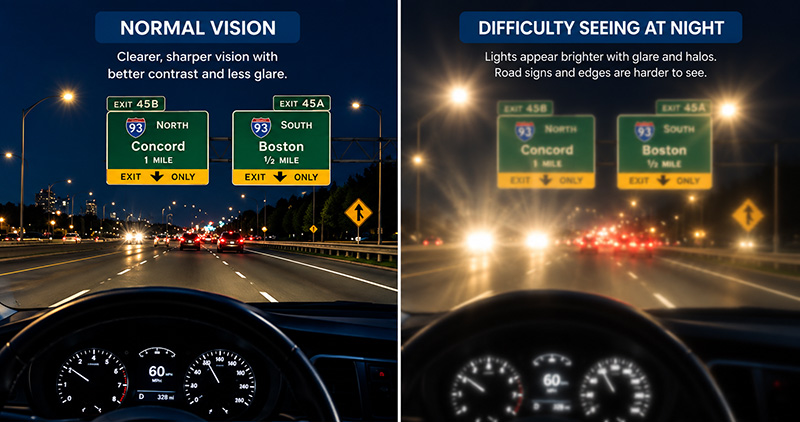
Difficulty seeing at night, also called poor night vision or night blindness, can make it harder to drive, read road signs, see pedestrians, adjust to darkness, or feel comfortable in dim lighting. Many patients first notice the problem while driving after sunset, especially with glare from headlights.
Night vision problems can be caused by cataracts, dry eye, outdated glasses, nearsightedness, astigmatism, retinal disease, glaucoma, or other eye conditions. Because several treatable conditions can affect night vision, a comprehensive eye exam is the best way to identify the cause.
What Does Poor Night Vision Feel Like?
Patients often describe night vision problems as:
- Trouble driving at night
- Glare from headlights
- Halos around lights
- Starbursts around lights
- Difficulty seeing road signs
- Needing more light to read
- Trouble adjusting from bright light to darkness
- Vision that feels dim or shadowy
- Difficulty seeing in restaurants or low-light rooms
- Avoiding night driving because it feels unsafe
Common Causes of Difficulty Seeing at Night
Cataracts
Cataracts are one of the most common causes of night vision problems. As the natural lens becomes cloudy, light scatters inside the eye. This can cause glare, halos, cloudy vision, dim vision, and difficulty driving at night.
Outdated Glasses Prescription
Even a small amount of uncorrected nearsightedness, farsightedness, or astigmatism can feel worse at night because pupils enlarge in dim light. Updating your glasses or contact lens prescription may improve nighttime clarity.
Dry Eye Disease
Dry eye can cause fluctuating vision, glare, burning, tearing, and difficulty focusing. Symptoms often worsen with screen use, wind, low humidity, and prolonged driving.
Astigmatism
Astigmatism can cause lights to appear streaked, smeared, or starburst-like, especially at night.
Glaucoma
Glaucoma can reduce contrast sensitivity and peripheral vision over time. Some patients may notice difficulty in dim lighting or trouble navigating at night.
Macular Degeneration
Macular degeneration can affect central vision and contrast sensitivity, making it harder to see clearly in low-light conditions.
Diabetic Eye Disease
Diabetes can affect the retina and lens, causing blurry vision, fluctuating vision, glare, or difficulty seeing at night.
Retinal Conditions
Certain retinal conditions can affect the cells responsible for low-light vision. Symptoms may include poor night vision, peripheral vision changes, or difficulty adapting to darkness.
Prior Eye Surgery or Lens Implant Issues
Some patients notice glare, halos, or night vision symptoms after eye surgery. A careful exam can determine whether symptoms are related to dry eye, prescription, corneal changes, lens implant position, or other causes.
When Is Poor Night Vision an Emergency?
Difficulty seeing at night is often gradual, but urgent evaluation is needed if symptoms occur with:
- Sudden vision loss
- Eye pain
- Redness
- New flashes or floaters
- A curtain or shadow in vision
- Sudden increase in halos
- Severe headache
- Nausea or vomiting
- New neurologic symptoms
Sudden halos with eye pain, headache, nausea, or redness may be a sign of acute angle-closure glaucoma and requires emergency care.
How Is Difficulty Seeing at Night Diagnosed?
An eye exam for poor night vision may include:
- Visual acuity testing
- Refraction
- Glare testing
- Slit lamp examination
- Cataract evaluation
- Corneal evaluation
- Dry eye testing
- Eye pressure measurement
- Dilated retinal examination
- OCT imaging
- Retinal photography
- Visual field testing when needed
The goal is to determine whether the problem is coming from the prescription, tear film, cornea, lens, retina, optic nerve, or another cause.
Treatment for Difficulty Seeing at Night
Treatment depends on the cause. If the problem is a glasses prescription, updated glasses or contact lenses may improve nighttime clarity.
If dry eye is contributing, treatment may include artificial tears, prescription drops, lid care, warm compresses, LipiFlow, IPL, or other advanced dry eye therapies.
If cataracts are the cause, cataract surgery may improve clarity, glare, contrast, and night driving when symptoms interfere with daily activities.
If glaucoma, macular degeneration, diabetic eye disease, or retinal disease is present, treatment focuses on protecting vision and managing the underlying condition.
Can Night Driving Problems Be Improved?
Often, yes. Many patients improve with a more accurate glasses prescription, dry eye treatment, cataract surgery, or management of an underlying eye condition. However, night vision symptoms should not be ignored, especially if they are worsening or affecting driving safety.
Frequently Asked Questions
Why is it hard for me to see at night?
Poor night vision may be caused by cataracts, astigmatism, nearsightedness, dry eye, glaucoma, macular degeneration, diabetic eye disease, or retinal problems.
Why do headlights bother me at night?
Headlight glare can occur from cataracts, dry eye, astigmatism, corneal irregularity, large pupils, or lens changes inside the eye.
Are halos around lights at night normal?
Occasional halos can occur, but new, worsening, or painful halos should be evaluated. Halos may be caused by cataracts, dry eye, corneal swelling, glaucoma, or prescription problems.
Can cataracts cause difficulty seeing at night?
Yes. Cataracts commonly cause glare, halos, dim vision, cloudy vision, and difficulty driving at night.
Can glasses help with night driving?
Yes, if the problem is caused by nearsightedness, farsightedness, astigmatism, or an outdated prescription. An eye exam can determine whether new glasses will help.
Why is my vision worse in dim light?
In dim light, the pupils enlarge, which can make cataracts, astigmatism, corneal irregularity, and prescription problems more noticeable.
When should I stop driving at night?
If night driving feels unsafe, you should avoid driving after dark until you are evaluated. Difficulty seeing road signs, pedestrians, lane markings, or oncoming traffic glare can increase risk.
Is night blindness serious?
Night blindness can be caused by common treatable problems, but it can also be associated with retinal disease or other eye conditions. Persistent or worsening symptoms should be checked.
Patient Testimonials
Night Driving Should Feel Safe
If glare, halos, dim vision, or trouble seeing road signs are making night driving difficult, an eye exam can help identify the cause. Schedule a comprehensive eye exam with NH Eye Associates today to evaluate your night vision and find the right treatment option.