
Sudden Vision Loss
Why Immediate Evaluation Matters
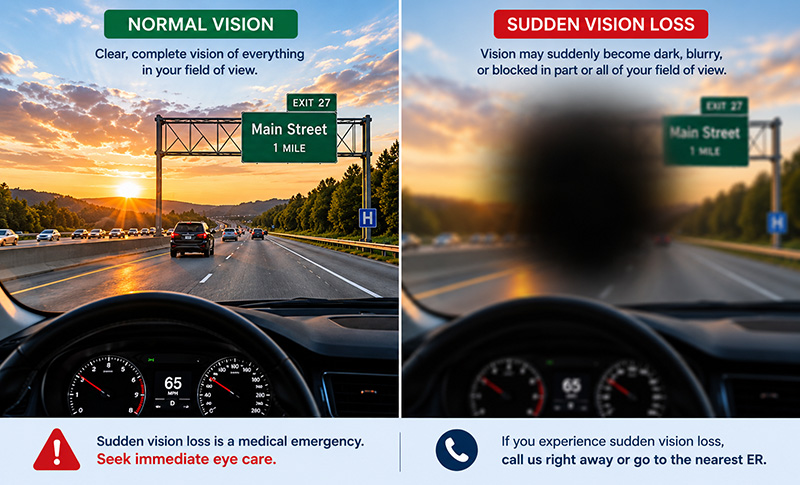
Sudden vision loss means a noticeable decrease in vision that happens quickly, either over seconds, minutes, hours, or a short period of time. It may affect one eye or both eyes. Vision may become dark, blurry, cloudy, distorted, partially missing, or completely absent.
Sudden vision loss should always be treated seriously. Some causes are eye-related, while others may involve circulation, inflammation, the optic nerve, or the brain. Prompt diagnosis can be critical for protecting vision and identifying potentially serious medical conditions.
What Does Sudden Vision Loss Feel Like?
Patients may describe sudden vision loss as:
- A dark curtain or shadow over vision
- Sudden blurry vision in one eye
- Sudden cloudy or gray vision
- Missing areas of vision
- A black spot in the center of vision
- Sudden loss of side vision
- Vision going dim or dark
- New distortion or wavy vision
- Sudden vision loss with flashes or floaters
- Temporary vision loss that later improves
Even if vision returns, sudden or temporary vision loss should be evaluated promptly.
When Is Sudden Vision Loss an Emergency?
Seek emergency medical care immediately if sudden vision loss occurs with:
- Weakness or numbness
- Facial drooping
- Trouble speaking
- Severe headache
- Dizziness or loss of balance
- Eye pain
- New flashes or many new floaters
- A curtain or shadow in vision
- Double vision
- Jaw pain or scalp tenderness
- Recent trauma
- Sudden vision loss in both eyes
Do not wait to see if symptoms improve. Sudden vision loss may be a sign of retinal detachment, retinal artery occlusion, stroke, optic nerve disease, acute glaucoma, or other urgent conditions.
Common Causes of Sudden Vision Loss
Retinal Detachment
A retinal detachment occurs when the retina pulls away from the back wall of the eye. Symptoms may include flashes, floaters, blurry vision, or a curtain-like shadow. This requires urgent evaluation and treatment.
Retinal Tear
A retinal tear can cause new flashes, floaters, or shadowing. Treating a tear early may help reduce the risk of retinal detachment.
Retinal Artery Occlusion
A retinal artery occlusion occurs when blood flow to the retina is blocked. This can cause sudden, painless, severe vision loss in one eye and requires emergency evaluation.
Retinal Vein Occlusion
A retinal vein occlusion occurs when a vein in the retina becomes blocked, causing bleeding, swelling, and sudden blurry or decreased vision.
Vitreous Hemorrhage
Bleeding into the gel inside the eye can cause sudden floaters, haze, shadows, or major vision loss. It may be related to diabetes, retinal tears, retinal vein occlusion, trauma, or other retinal disease.
Stroke or TIA
Sudden vision loss can sometimes be caused by a stroke or transient ischemic attack. Vision loss with neurologic symptoms should be treated as an emergency.
Optic Neuritis
Optic neuritis is inflammation of the optic nerve. It may cause decreased vision, pain with eye movement, dimming, color changes, or vision loss.
Giant Cell Arteritis
In adults over age 50, sudden vision loss with headache, jaw pain, scalp tenderness, fatigue, or unexplained weight loss may be a sign of giant cell arteritis. This is an emergency because the other eye may be at risk.
Acute Angle-Closure Glaucoma
This condition can cause sudden blurry or cloudy vision, halos, severe eye pain, redness, headache, nausea, and vomiting. It requires emergency treatment.
Macular Disease
Wet macular degeneration, macular bleeding, diabetic macular edema, or other macular problems may cause sudden central blur, distortion, or a dark spot.
Eye Trauma
Injury to the eye or head can cause bleeding, retinal damage, corneal injury, lens dislocation, optic nerve injury, or other serious problems.
Sudden Vision Loss in One Eye vs. Both Eyes
Sudden vision loss in one eye often suggests a problem within that eye, retina, optic nerve, or blood supply to the eye. Sudden vision loss in both eyes may involve both eyes, the optic nerves, circulation, or the brain and should be evaluated urgently.
A helpful first step is to gently cover one eye at a time to determine whether one eye or both eyes are affected, but this should not delay emergency care.
How Is Sudden Vision Loss Diagnosed?
Evaluation may include:
- Visual acuity testing
- Pupil examination
- Eye pressure measurement
- Slit lamp examination
- Dilated retinal exam
- OCT imaging
- Retinal photography
- Widefield retinal imaging
- Visual field testing
- Ultrasound of the eye when the retina cannot be clearly seen
- Blood pressure assessment
- Bloodwork or emergency imaging when indicated
- Referral to emergency care, retina, neurology, or primary care when needed
The goal is to identify whether vision loss is caused by the cornea, lens, retina, optic nerve, eye pressure, circulation, or the brain.
Treatment for Sudden Vision Loss
Treatment depends on the cause and timing.
Retinal tears may be treated with laser. Retinal detachment may require urgent surgical repair. Retinal vein occlusion or wet macular degeneration may require eye injections. Acute glaucoma requires rapid pressure-lowering treatment. Inflammatory or neurologic causes may require medication and coordination with other specialists.
Because treatment windows can be limited, prompt evaluation is essential.
Frequently Asked Questions
Is sudden vision loss an emergency?
Yes. Sudden vision loss should be treated as urgent because it may be caused by retinal detachment, vascular blockage, stroke, glaucoma, optic nerve disease, or inflammation.
What should I do if I suddenly lose vision in one eye?
Seek emergency medical or eye care immediately. Do not wait for symptoms to improve, even if the vision loss is painless.
Can sudden vision loss be temporary?
Yes. Temporary vision loss can occur with migraine, circulation problems, TIA, retinal issues, or other causes. Even temporary vision loss should be evaluated.
What does a retinal detachment feel like?
A retinal detachment may cause flashes, floaters, blurry vision, missing vision, or a curtain-like shadow. It is an emergency.
Can stroke cause vision loss?
Yes. Stroke or TIA can cause sudden vision loss, double vision, missing vision, or visual field loss, especially with neurologic symptoms.
Can high blood pressure or diabetes cause sudden vision loss?
Yes. High blood pressure and diabetes can contribute to retinal bleeding, swelling, vascular blockage, and other vision-threatening conditions.
Is sudden painless vision loss serious?
Yes. Serious conditions such as retinal artery occlusion, retinal detachment, vitreous hemorrhage, or optic nerve problems may cause painless vision loss.
Can eye pain with vision loss be serious?
Yes. Eye pain with vision loss may be caused by acute glaucoma, inflammation, infection, corneal disease, trauma, or optic nerve inflammation and requires urgent evaluation.
Patient Testimonials
Sudden Vision Loss Should Never Be Ignored
If you experience sudden vision loss, a curtain or shadow, new flashes or floaters, eye pain, or sudden vision changes, seek urgent care immediately.
Call NH Eye Associates right away or go to the nearest emergency department if symptoms are severe, sudden, or associated with neurologic warning signs.