
Lower Eyelid Bags & Dark Circles
Lower eyelid bags, puffiness, and dark circles can make the eyes appear tired, older, or less refreshed—even when you feel well rested. These changes may develop from aging, genetics, prominent lower eyelid fat, skin laxity, facial anatomy, allergies, or changes in skin pigmentation.
At NH Eye Associates, our ophthalmic and facial aesthetic specialists evaluate the structures around the eyes to determine what is contributing to your appearance and whether treatment may help. Depending on the cause, options may include skincare, injectable treatments, or lower eyelid surgery (lower blepharoplasty).
Concerned about bags or dark circles beneath your eyes?
Schedule an eyelid and facial rejuvenation consultation with NH Eye Associates.
What are lower eyelid bags?
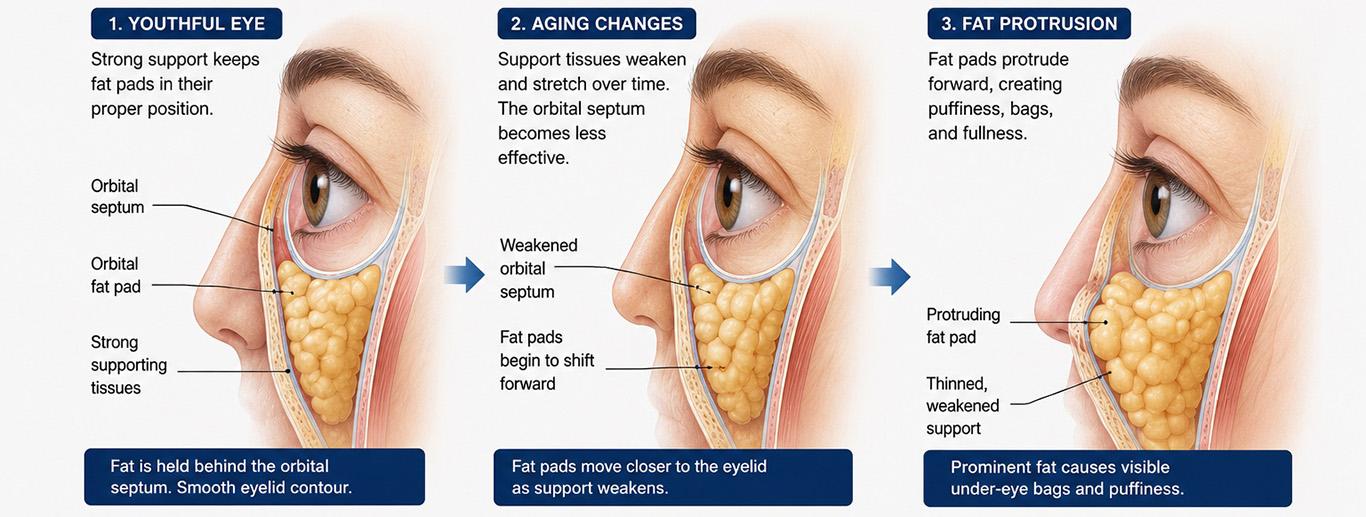
Lower eyelid bags are areas of fullness or puffiness that develop beneath the eyes. The lower eyelid contains small fat compartments that help cushion and protect the eye. With aging, the tissues that normally hold this fat in place can weaken, allowing the fat to become more prominent. At the same time, the skin and supporting tissues of the lower eyelid may become looser.
This can create:
- Puffy lower eyelids
- Bulges beneath the eyes
- Loose or crepey skin
- A deeper groove between the eyelid and cheek
- Shadows beneath the eyes
- A chronically tired appearance
Lower eyelid bags can occur at almost any age when inherited facial anatomy is a major factor.
How Aging Causes Fat Protrusion
With age, the tissues that support the eyelids and hold fat in place weaken. Fat pads shift forward, creating puffiness and under-eye bags.
What causes bags under the eyes?
Several factors may contribute to under-eye bags.
Aging
Aging is one of the most common causes.
Over time:
- Eyelid skin becomes thinner
- Collagen and elasticity decrease
- Supporting tissues weaken
- Lower eyelid fat may become more prominent
- The junction between the eyelid and cheek may become more noticeable
These changes can produce both puffiness and shadowing underneath the eyes.
Genetics
Some people naturally have more prominent lower eyelid fat or deeper tear troughs. Under-eye bags can therefore develop even in patients in their 20s, 30s, or 40s.
Fluid Retention
Temporary puffiness may become worse after:
- Eating high-sodium foods
- Crying
- Poor sleep
- Alcohol consumption
- Hormonal changes
Fluid-related puffiness may fluctuate throughout the day, while structural eyelid bags tend to remain more consistent.
Allergies and Eye Rubbing
Seasonal allergies may cause swelling, congestion, itching, and repeated rubbing around the eyes. These factors can make puffiness and dark circles more noticeable.
Skin and Facial Changes
Loss of facial volume and changes in the upper cheek can make the lower eyelid appear more hollow or prominent. The combination of a prominent fat pocket immediately above a hollow tear trough can exaggerate the appearance of an under-eye bag.
What Causes a Droopy Eyelid?
There are several types and causes of ptosis.
Age-Related Ptosis
The most common form of ptosis in adults is age-related, or involutional, ptosis. A muscle called the levator muscle raises the upper eyelid. With aging, the levator tendon can stretch, thin, or partially separate from its attachment to the eyelid. As a result, the eyelid gradually begins to droop. Age-related ptosis may affect one eye more than the other.
Congenital Ptosis
Some children are born with a drooping eyelid because the levator muscle did not develop normally. Significant congenital ptosis may interfere with normal visual development and can sometimes contribute to amblyopia, or lazy eye. Children with noticeable eyelid drooping should receive a comprehensive eye examination.
Neurologic Ptosis
Certain nerves control the muscles responsible for eyelid position. Neurologic conditions affecting these nerves can occasionally cause sudden or progressive ptosis. A new drooping eyelid associated with:
- Double vision
- Abnormal pupil size
- Facial weakness
- Severe headache
- Difficulty speaking
- Weakness or numbness
may require urgent medical evaluation.
Muscle-Related Ptosis
Conditions affecting the muscles responsible for eyelid movement may also cause ptosis. Some muscle disorders can produce eyelid drooping that changes throughout the day or becomes more noticeable with fatigue.
Ptosis After Eye Surgery
Occasionally, ptosis may develop or become more noticeable following eye surgery. This can occur because of changes to the levator muscle or its tendon. Your ophthalmologist can determine whether the condition is temporary or whether treatment should be considered.
Trauma or Injury
Injury to the eyelid, eye socket, muscles, or nerves controlling the upper eyelid can also result in ptosis.
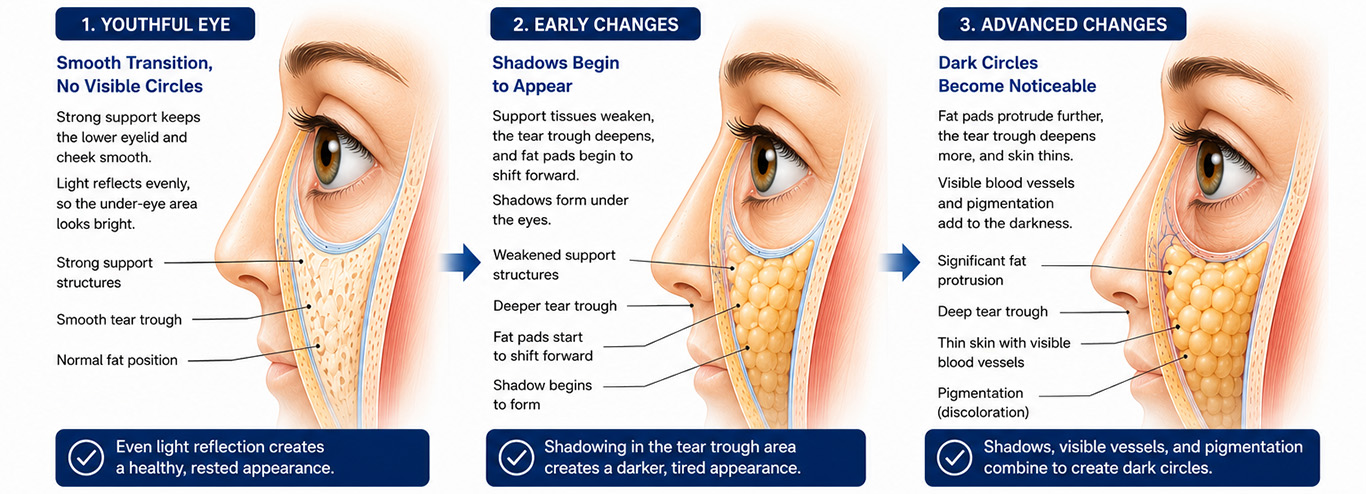
How Lower Eyelid Circles Form
Dark circles develop when changes under the eyes create shadows, show-through of blood vessels, or increased pigmentation. These changes often occur gradually with age.
Why Do I Have Dark Circles Under My Eyes?
Dark circles do not always result from pigmentation. Several different anatomical changes can create a dark appearance beneath the eyes.
Tear-Trough Shadowing
The tear trough is the groove extending from the inner lower eyelid toward the cheek. When this groove becomes deeper, overhead lighting can create a shadow that appears as a dark circle.
Thin Lower Eyelid Skin
Lower eyelid skin is among the thinnest skin on the body. Blood vessels and underlying tissues may therefore become more visible as the skin thins with age.
Skin Pigmentation
Some patients naturally have increased pigmentation beneath the eyes. Sun exposure and certain skin conditions may make pigmentation more noticeable.
Prominent Lower Eyelid Fat
A bulging fat pocket can cast a shadow immediately beneath it. In these patients, what appears to be a dark circle may actually be caused largely by eyelid contour rather than pigmentation.
Facial Volume Loss
Loss of volume in the upper cheek can deepen the eyelid-cheek junction and make the eyes appear more hollow or tired.
Lower Eyelid Bags vs. Dark Circles
Although they often occur together, lower eyelid bags and dark circles are not necessarily the same problem.
Lower eyelid bags usually involve physical fullness or protruding tissue.
Dark circles may result from:
- Shadows
- Tear-trough hollows
- Thin skin
- Visible blood vessels
- Pigmentation
- Prominent eyelid fat
- Facial anatomy
Identifying the underlying cause is important because different problems require different treatments.
Why Do My Eyes Look Tired Even When I Am Not?
The appearance of tired eyes is often related more to anatomy than to sleep.
Changes such as:
- Lower eyelid bags
- Tear-trough hollows
- Loose eyelid skin
- Dark circles
- Upper eyelid skin redundancy
- Drooping eyebrows
can create a tired appearance even after adequate sleep.
A comprehensive eyelid evaluation can help determine which structures are contributing most to your appearance.
When Should I See an Eyelid Specialist?
Consider an evaluation when lower eyelid bags or dark circles:
- Persist despite adequate sleep
- Become increasingly prominent
- Make you appear tired or older than you feel
- Are associated with loose lower eyelid skin
- Create a deep eyelid-cheek groove
- Affect your confidence in your appearance
- Lead you to consider cosmetic treatment or eyelid surgery
An eyelid specialist can distinguish between problems involving the skin, fat compartments, eyelid position, tear trough, and surrounding facial tissues.
How Are Lower Eyelid Bags Evaluated?
An evaluation begins with determining why the bags or circles have developed.
Your doctor may assess:
Lower Eyelid Fat
Prominent fat compartments are one of the most common contributors to visible bags.
Skin Laxity
Loose or crepey skin may contribute to an aged appearance.
Tear Trough
A deep groove beneath the eyelid may exaggerate both bags and shadows.
Eyelid Position
The strength and position of the lower eyelid are important when planning treatment.
Midface and Cheek Anatomy
Volume loss or descent of the cheek can affect the transition between the lower eyelid and face.
Skin Quality and Pigmentation
Pigmentation, sun damage, and skin thickness may contribute to dark circles independently of eyelid bags.
Treatment for Lower Eyelid Bags and Dark Circles
Treatment depends on the underlying cause and your cosmetic goals.
Lower Blepharoplasty
Lower blepharoplasty is a surgical procedure designed to improve prominent lower eyelid bags and related aging changes.
Depending on the patient, surgery may involve:
- Removing excess fat
- Repositioning lower eyelid fat
- Improving the eyelid-cheek transition
- Removing selected excess skin
- Tightening supporting tissues when necessary
- The goal is generally to create a smoother, more rested appearance while preserving natural eyelid shape.
Fat Repositioning
Rather than simply removing lower eyelid fat, fat can sometimes be repositioned into the tear-trough area. This approach may smooth the transition between the lower eyelid and cheek while reducing the appearance of both a bulge and the hollow beneath it. The appropriate technique depends on each patient's anatomy.
Injectable Treatments
For selected patients, injectable treatments may help improve certain contours around the eyes and face. Dermal fillers such as JUVÉDERM® may sometimes be considered for facial volume restoration or contour improvement. Not every patient with under-eye bags is an appropriate candidate for filler. Patients with significant lower eyelid fat protrusion or swelling may benefit more from surgical evaluation.
Botox
Botox does not remove lower eyelid bags, but it may improve wrinkles around the outer corners of the eyes, commonly called crow's feet. Combining treatments may help address several components of facial aging when appropriate.
Skin Treatments
When pigmentation, texture, or sun damage contributes to dark circles, skincare or other aesthetic treatments may be considered. These treatments generally do not eliminate structural fat bags.
Can Lower Eyelid Bags Go Away Without Surgery?
Temporary swelling caused by fluid retention, allergies, or lack of sleep may improve without surgery. True structural lower eyelid bags caused by prominent fat compartments and age-related tissue changes usually do not disappear with creams, cold compresses, or additional sleep. These measures may temporarily reduce swelling but do not reposition prominent eyelid fat. For patients bothered by persistent structural bags, lower blepharoplasty may provide a longer-lasting improvement.
Lower Blepharoplasty for Under-Eye Bags
Lower blepharoplasty is one of the primary surgical options for persistent lower eyelid bags.
Surgery is customized to the patient's anatomy rather than performed identically for every patient.
Possible goals include:
- Reducing prominent fat pockets
- Smoothing the eyelid-cheek junction
- Improving tear-trough contour
- Reducing excess skin
- Maintaining appropriate lower eyelid support
- Creating a refreshed but natural appearance
Will Lower Blepharoplasty Fix Dark Circles?
Sometimes—but it depends on what is causing the darkness.
Lower blepharoplasty may significantly improve dark circles caused primarily by:
- Shadowing from lower eyelid bags
- A deep eyelid-cheek junction
- Prominent fat adjacent to a tear trough
It will generally have less effect on darkness caused primarily by skin pigmentation.
An evaluation helps determine how much improvement can reasonably be expected.
Am I a Candidate for Lower Eyelid Surgery?
You may be a potential candidate when you have:
- Persistent lower eyelid bags
- Prominent lower eyelid fat
- Loose eyelid skin
- Deep tear troughs
- An aged or tired appearance beneath the eyes
- Realistic expectations regarding treatment
Your overall health, eye health, eyelid position, dry-eye symptoms, and facial anatomy are also important.
Lower Eyelid Bags and Upper Eyelid Aging
Lower eyelid bags frequently occur together with aging changes of the upper eyelids.
Some patients also have:
- Excess upper eyelid skin
- Dermatochalasis
- Drooping eyelids
- Brow descent
- Forehead lines
- Crow's feet
Treating only one area may not always address the overall appearance of the eyes.
Your consultation can evaluate both upper and lower eyelid anatomy.
Lower Eyelid Bags vs. Swollen Eyelids
Persistent lower eyelid bags should be distinguished from sudden eyelid swelling.
Bags usually develop gradually and are often related to anatomy or aging.
Swelling may occur because of:
- Allergies
- Infection
- Inflammation
- Fluid retention
- Eyelid conditions
Sudden, painful, red, or one-sided swelling should be medically evaluated rather than assumed to be cosmetic.
A More Rested, Natural Appearance
The goal of lower eyelid rejuvenation is not to change what makes you look like yourself. It is to address the anatomical changes that create persistent bags, shadows, and a tired appearance while preserving natural eyelid shape and facial balance.
At NH Eye Associates, our team can determine whether your concerns are related primarily to eyelid fat, skin, tear-trough anatomy, pigmentation, or another condition and discuss treatment options tailored to you.
Frequently Asked Questions About Lower Eyelid Bags & Dark Circles
What is the main cause of bags under the eyes?
Aging and genetics are among the most common causes. Weakening of the tissues supporting the lower eyelid can allow underlying fat to become more prominent.
Why do I have under-eye bags even when I sleep well?
Structural eyelid bags are often caused by genetics, prominent lower eyelid fat, or aging rather than lack of sleep. Sleep may affect temporary puffiness but usually does not eliminate true fat bags.
What is the difference between eye bags and dark circles?
Eye bags are areas of physical fullness beneath the eyes. Dark circles describe the appearance of darkness, which may result from shadows, pigmentation, thin skin, visible blood vessels, or tear-trough hollows.
Can creams get rid of under-eye bags?
Creams may improve hydration or the appearance of the skin but generally cannot remove prominent lower eyelid fat.
Does Botox remove bags under the eyes?
No. Botox primarily relaxes targeted muscles and can improve dynamic wrinkles such as crow's feet. It does not remove protruding lower eyelid fat.
Can filler treat dark circles?
Filler may help selected patients whose dark circles are caused partly by tear-trough hollowing or facial volume loss. It is not appropriate for everyone, particularly patients with significant lower eyelid bags or swelling.
What surgery gets rid of bags under the eyes?
Lower blepharoplasty is the primary cosmetic eyelid procedure used to address persistent lower eyelid bags.
Is lower blepharoplasty permanent?
The structural changes created during surgery can be long lasting, although the face and eyelids continue to age naturally over time.
Can lower blepharoplasty improve tear troughs?
Yes. In selected patients, repositioning lower eyelid fat can help smooth the transition between the lower eyelid and cheek.
Will lower blepharoplasty remove dark circles completely?
Not necessarily. Surgery may improve dark circles caused by shadows and contour abnormalities, but pigmentation-related darkness may remain.
At what age should I consider lower blepharoplasty?
There is no single correct age. Some patients develop inherited lower eyelid bags relatively young, while others notice them primarily as part of aging later in life.
Should an ophthalmologist evaluate my lower eyelids before cosmetic surgery?
Evaluation by a physician experienced in eyelid anatomy can be particularly helpful because the eyelids have important protective functions for the eyes. Eyelid position, ocular surface health, tearing, and dry-eye symptoms may all be considered when planning surgery.
What causes lower eyelid bags and dark circles?
Lower eyelid bags commonly develop when aging or genetics cause the fat beneath the lower eyelid to become more prominent. Dark circles may result from shadows created by eyelid bags, tear-trough hollows, thin skin, visible blood vessels, pigmentation, or facial volume loss. Treatment depends on the underlying cause and may include skincare, injectable treatments, or lower blepharoplasty.
Patient Testimonials
Schedule a Lower Eyelid Evaluation
Persistent under-eye bags or dark circles do not always have the same cause. A personalized evaluation is the best way to understand which treatments are most appropriate for your anatomy and goals.
Schedule a consultation with NH Eye Associates to discuss lower eyelid bags, dark circles, and facial rejuvenation options.