
Swollen Eyelids
Causes, Treatment & When to See an Eye Doctor
A swollen or puffy eyelid can develop for many reasons, ranging from allergies and blocked oil glands to infection, inflammation, or age-related changes around the eyes.
Some patients experience sudden eyelid swelling, while others notice gradual puffiness or fullness that develops over years. Aging can weaken the tissues that normally hold orbital fat in place, allowing the fat pads around the eye to become more prominent and create persistent upper- or lower-eyelid fullness.
At NH Eye Associates, our ophthalmologists and optometrists evaluate swollen eyelids to determine whether the problem is related to inflammation, infection, an eyelid gland disorder, an eyelid lesion, or structural changes that may benefit from oculoplastic treatment.
Concerned about a swollen or persistently puffy eyelid?
What causes Swollen Eyelids?
Swollen eyelids occur when fluid, inflammation, tissue changes, or another process causes enlargement of the upper or lower eyelid.
The cause may be temporary or chronic and may affect:
- One eyelid
- Both eyelids
- The upper eyelid
- The lower eyelid
- The tissues surrounding the eye
Common causes include allergies, blepharitis, styes, chalazia, infections, dermatitis, trauma, thyroid eye disease, fluid retention, and age-related eyelid changes with protruding fat pads.
Aging and Fat Protrusion: A Major Cause of Puffy Eyelids
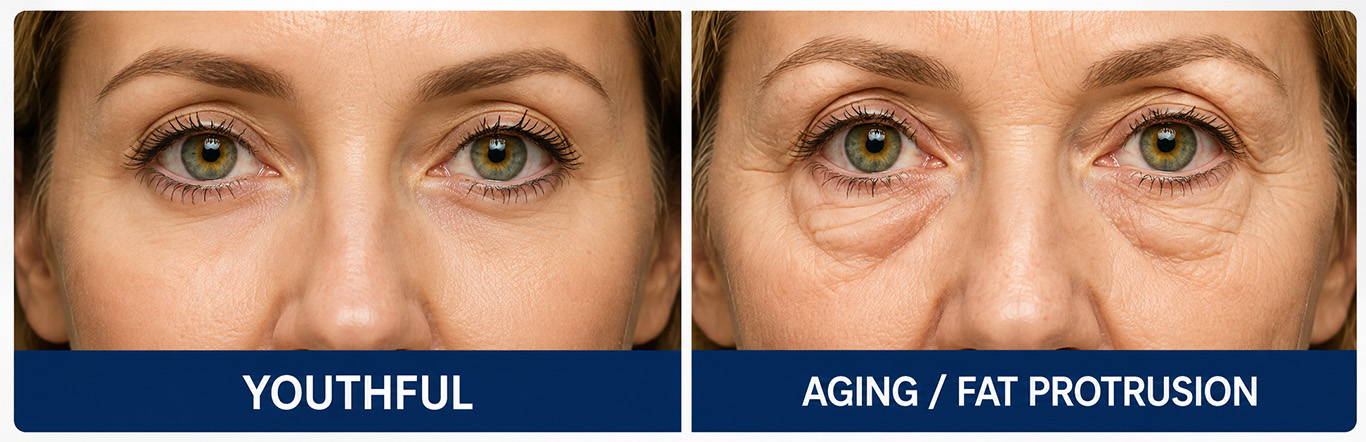
Not all swollen-looking eyelids are caused by inflammation. For many adults, especially when puffiness develops gradually and remains relatively constant, the underlying problem is age-related change in the eyelid tissues.
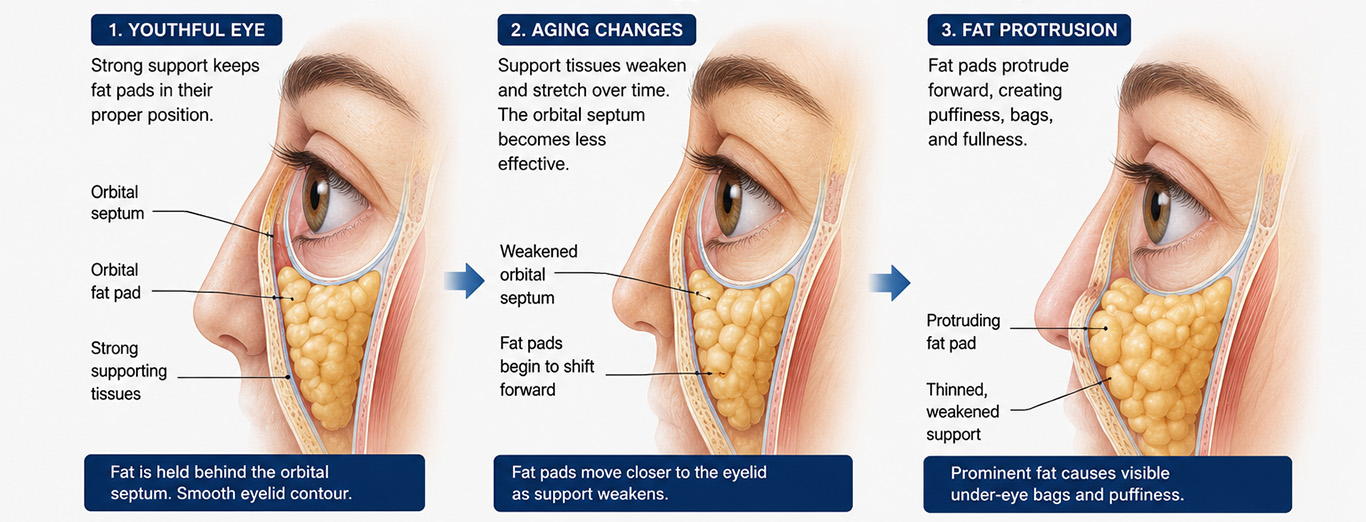
The eyes are naturally surrounded by fat that provides cushioning within the orbit. With age, supporting tissues can weaken and the orbital septum can become less effective at holding those fat pads farther back. The fat may then protrude forward, contributing to a fuller or “baggy” appearance of the upper or lower eyelids.
What Does Eyelid Fat Protrusion Look Like?
Patients may notice:
- Bags beneath the eyes
- Persistent lower-eyelid puffiness
- Fullness beneath one or both eyes
- Bulging fat pads
- Heavy or puffy upper eyelids
- Loose upper-eyelid skin
- A chronically tired appearance
- Puffiness that does not disappear with allergy treatment or compresses
Unlike an infection or allergy, age-related fat protrusion typically develops gradually and is generally not associated with marked redness, itching, fever, or sudden pain.
How Aging Causes Fat Protrusion
With age, the tissues that support the eyelid and hold fat in place weaken. Fat pads shift forward, creating puffiness and under-eye bags.
Why Do Eyelids Become Puffy With Age?
Several changes may occur simultaneously.
Weakening of Eyelid Support
The tissues that separate orbital fat from the eyelid can weaken over time, allowing the fat to become more visible.
Loss of Skin Elasticity
The eyelid skin can become looser and more redundant with age. This is known as dermatochalasis and can occur in both the upper and lower eyelids.
Protruding Fat Pads
Fat that once remained farther back within the orbit may become more prominent, particularly beneath the lower eyelids.
Changes in the Eyelid-Cheek Junction
Changes in facial volume and support can make under-eye bags and shadows appear even more noticeable.
These changes can combine to produce what patients commonly describe as puffy eyes, swollen eyelids, or bags under the eyes.
Can Blepharoplasty Treat Puffy Eyelids From Aging?
Yes, in appropriately selected patients. Blepharoplasty is eyelid surgery designed to improve excess eyelid skin, prominent fat, and other age-related eyelid changes. Upper-eyelid surgery may address redundant skin and associated structural changes, while lower blepharoplasty can remove, sculpt, or reposition protruding fat responsible for under-eye bags.
The goal is not simply to “remove fat.” Modern eyelid surgery may involve selectively removing or repositioning tissue to maintain a natural contour and avoid an overly hollow appearance.
Swollen Eyelids From Allergies
Allergies are another frequent cause of eyelid swelling.
Potential triggers include:
- Pollen
- Dust
- Pet dander
- Cosmetics
- Skin-care products
- Eye drops
- Contact lens solutions
Allergic eyelid swelling commonly occurs with:
- Itching
- Watery eyes
- Redness
- Eye rubbing
- Swelling affecting both eyes
Avoiding the suspected trigger and treating the underlying allergy may improve symptoms.
Blepharitis and Meibomian Gland Dysfunction
Blepharitis is inflammation involving the eyelid margins.
It can cause:
- Puffy eyelids
- Eyelid redness
- Burning
- Itching
- Crusting along the eyelashes
- Gritty eyes
- Dry-eye symptoms
Certain forms of blepharitis produce redness and edema directly along the eyelid margin. Blepharitis frequently occurs together with meibomian gland dysfunction and dry eye.
Styes and Chalazia
A stye or chalazion can produce localized eyelid swelling. A stye commonly presents as a tender red bump near the eyelid margin. A chalazion develops when an eyelid oil gland becomes blocked and may produce a firm lump within the eyelid. The surrounding eyelid can become significantly swollen, particularly early in the process.
Preseptal Callulitis
Preseptal cellulitis is an infection involving the eyelid and tissues in front of the orbital septum.
It can cause substantial:
- Eyelid swelling
- Redness
- Tenderness
- Warmth
Because infections around the eye can occasionally progress or resemble more serious orbital disease, significant eyelid swelling associated with infection should be evaluated.
The American Academy of Ophthalmology distinguishes preseptal cellulitis from orbital cellulitis, which involves deeper tissues within the eye socket and is considerably more serious.
When Is a Swollen Eyelid an Emergency?
Most swollen eyelids are not emergencies. However, eyelid swelling accompanied by certain symptoms requires urgent medical evaluation.
Seek prompt care for:
- Decreased vision
- Severe eye pain
- Pain when moving the eye
- Difficulty moving the eye
- A bulging or protruding eye
- Fever
- Rapidly worsening swelling
- Significant redness surrounding the eye
- Severe headache associated with eye symptoms
- Significant trauma
Orbital cellulitis can cause swollen eyelids along with restricted eye movement, vision problems, and protrusion of the eye and requires urgent treatment. Do not wait for a routine eye appointment if these symptoms are present.
Contact Dermatitis and Eyelid Irritation
The eyelid skin is thin and sensitive.
Products that can trigger irritation or contact dermatitis include:
- Makeup
- Eye creams
- Sunscreen
- Facial cleansers
- Shampoo
- Hair products
- Eye drops
- Soap
The eyelids may become swollen, itchy, red, dry, or flaky.
Recently introducing a new cosmetic or skin-care product can provide an important clue.
Conjunctivitis
Conjunctivitis can cause eyelid swelling along with:
- Red eyes
- Watering
- Irritation
- Discharge
- Crusting
Conjunctivitis can be allergic, infectious, or inflammatory.
Thyroid Eye Disease
Thyroid eye disease can affect the muscles, fat, eyelids, and other tissues around the eyes.
Possible symptoms include:
- Swelling around the eyes
- Eyelid retraction
- Dry or irritated eyes
- Eye redness
- Bulging eyes
- Pressure behind the eyes
- Double vision
Why Is Only One Eyelid Swollen?
One-sided eyelid swelling is often caused by a localized problem.
Possible causes include:
- Stye
- Chalazion
- Blocked oil gland
- Preseptal cellulitis
- Insect bite
- Trauma
- Local allergic reaction
- Cyst
- Eyelid lesion
A persistent lump or repeated swelling in the same location deserves evaluation.
Why Are Both Eyelids Puffy?
Swelling or puffiness involving both eyes can result from:
- Allergies
- Blepharitis
- Fluid retention
- Dry eye and eyelid inflammation
- Dermatitis
- Age-related eyelid changes
- Protruding orbital fat
- Certain systemic conditions
One useful distinction is how quickly the puffiness developed.
Sudden itchy swelling suggests a different problem from slowly progressive under-eye bags that have developed over several years.
Why Are My Eyelids Puffy When I Wake Up?
Morning eyelid puffiness can occur when fluid temporarily accumulates in the tissues around the eyes during sleep.
It may be more noticeable in people with:
- Allergies
- Blepharitis
- Dry eye
- Eye rubbing
- Chronic eyelid inflammation
- Existing lower-eyelid bags
Age-related under-eye fullness may also appear more pronounced in the morning because temporary fluid accumulation can add to pre-existing structural puffiness.
Puffy Eyelids vs. Bags Under the Eyes
These terms overlap, but they do not always describe the same condition.
Puffy or Swollen Eyelids
This generally describes enlargement resulting from inflammation or fluid accumulation.
Examples include:
- Allergies
- Infection
- Dermatitis
- Blepharitis
Bags Under the Eyes
Persistent bags are often related more to anatomical and age-related changes, including protruding fat, skin laxity, and changes at the eyelid-cheek junction. Lower blepharoplasty is specifically designed to address appropriate cases of lower-eyelid bags caused by these structural changes.
Swollen Eyelid vs. Chalazion
A swollen eyelid is a symptom. A chalazion is one possible cause.
A chalazion usually produces a more localized bump within the eyelid.
Generalized swelling without a distinct lump may instead result from:
- Allergy
- Infection
- Blepharitis
- Dermatitis
- Trauma
How Are Swollen Eyelids Diagnosed?
The key question is not simply “How do we reduce the swelling?” It is: “What is causing the eyelid to look swollen?”
During an examination, your eye doctor may evaluate:
- Upper and lower eyelids
- Eyelid skin
- Eyelid position
- Eyelashes
- Meibomian glands
- Conjunctiva
- Cornea
- Tear film
- Eye movements
- Vision
- Surrounding orbital tissues
A slit-lamp examination provides a magnified view of the eyelids and ocular surface.
When age-related puffiness is suspected, the examination may also assess:
- Redundant eyelid skin
- Fat-pad prominence
- Upper-eyelid hooding
- Lower-eyelid bags
- Eyelid position
- Tear troughs
- Eyelid-cheek contour
This helps distinguish a medical cause of swelling from a structural eyelid condition.
How Are Swollen Eyelids Treated?
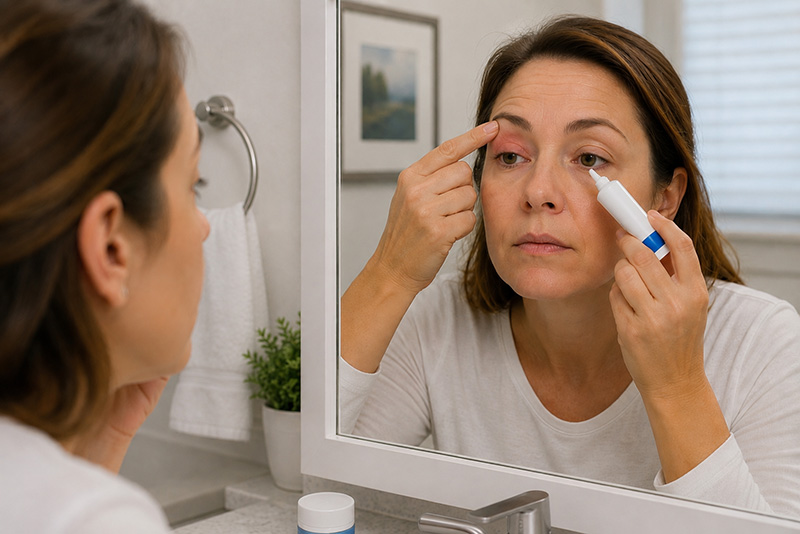
Treatment depends entirely on the diagnosis.
Cool Compresses
Cool compresses may temporarily reduce mild swelling related to allergies or irritation.
Warm Compresses
Warm compresses may help when swelling results from blocked meibomian glands, some chalazia, or certain forms of blepharitis.
Eyelid Hygiene
Patients with blepharitis or meibomian gland dysfunction may benefit from ongoing eyelid hygiene.
Allergy Treatment
Avoiding triggers and treating ocular allergy can improve allergy-related puffiness.
Prescription Medication
Some conditions require:
- Antibiotics
- Anti-inflammatory treatment
- Allergy medication
- Prescription eye drops
- Ophthalmic ointments
Treatment of a Chalazion
Persistent chalazia occasionally require an in-office procedure.
Blepharoplasty
When persistent puffiness is primarily caused by fat protrusion, excess skin, or other age-related structural changes, compresses and allergy medications will not correct the underlying anatomy. In appropriately selected patients, upper or lower blepharoplasty may provide a more definitive treatment.
Should I Use Ice or Heat on a Swollen Eyelid?
It depends on the cause. Cool compresses are often more appropriate for temporary allergy-related puffiness or irritation. Warm compresses are commonly used for blocked oil glands, chalazia, or some forms of blepharitis. Neither treatment corrects age-related protruding fat. Persistent swelling should therefore be diagnosed before repeatedly treating it at home.
Can Puffy Eyelids Be Permanent?
Yes. Temporary swelling caused by allergies or irritation may resolve. However, puffiness caused by structural changes such as:
- Protruding orbital fat
- Dermatochalasis
- Skin laxity
- Lower-eyelid bags
may remain or gradually become more noticeable.
This distinction is important because long-standing structural puffiness may be better evaluated within an oculoplastic or blepharoplasty consultation rather than treated as an inflammatory condition.
When Should I See an Eye Doctor for Swollen Eyelids?
Schedule an examination when:
- Swelling persists
- Swelling repeatedly returns
- Only one eyelid remains swollen
- You have a painful eyelid
- You have a persistent lump
- There is substantial redness
- You develop eye discharge
- The skin of the eyelid changes
- You repeatedly develop chalazia
- Puffiness has gradually worsened with age
- You are considering treatment for under-eye bags or excess eyelid skin
- You do not know what is causing the swelling
Seek urgent medical care for significant swelling accompanied by vision loss, fever, eye protrusion, severe pain, or painful/restricted eye movement.
Swollen & Puffy Eyelid Evaluation at NH Eye Associates
What looks like a swollen eyelid can have very different causes. Some patients have an allergy or blocked oil gland. Others have an infection requiring treatment. Still others have fat protrusion, excess eyelid skin, or another age-related change that creates persistent puffiness without true inflammation.
At NH Eye Associates, our eye care team can evaluate the eyelids and determine the most appropriate treatment pathway. Patients with structural or age-related eyelid concerns can also be evaluated through our oculoplastic services.
Frequently Asked Questions About Swollen Eyelids
What is the most common cause of swollen eyelids?
There is no single cause. Allergies, blepharitis, blocked oil glands, chalazia, dermatitis, infection, and age-related changes can all make the eyelids appear swollen or puffy.
Can aging cause swollen-looking eyelids?
Yes. Aging can weaken eyelid support tissues and allow orbital fat to protrude forward, while excess skin and changes in skin elasticity can create persistent eyelid fullness.
What causes bags under the eyes?
Under-eye bags can result from a combination of genetics, aging, tissue laxity, fluid, and prominent orbital fat. Long-standing bags associated with fat protrusion may be treated surgically with lower blepharoplasty in appropriate patients.
Does eyelid fat mean I am retaining fluid?
Not necessarily. Protruding orbital fat is a structural issue and is different from temporary fluid-related swelling.
Can blepharoplasty fix puffy eyelids?
It can when the puffiness is caused primarily by excess eyelid skin or prominent fat rather than infection, allergy, or inflammation. Upper and lower blepharoplasty address different anatomical problems.
How do I know whether my puffy eyes are aging or allergies?
Allergic swelling is more likely to fluctuate and often causes itching, watering, or redness. Age-related fat protrusion generally develops gradually and produces more persistent fullness or under-eye bags.
Why is only one eyelid swollen?
Localized swelling can be caused by a stye, chalazion, infection, insect bite, trauma, cyst, or eyelid lesion. Persistent unilateral swelling should be evaluated.
Why are my eyelids swollen in the morning?
Fluid can collect temporarily around the eyes during sleep. Allergies, blepharitis, eye rubbing, and pre-existing under-eye bags can make morning puffiness more noticeable.
Can blepharitis cause swollen eyelids?
Yes. Blepharitis can produce erythema and edema of the eyelid margins along with irritation and crusting.
Can a stye cause the whole eyelid to swell?
Yes. A stye can cause localized inflammation that sometimes produces substantial surrounding eyelid swelling.
Can an infection cause swollen eyelids?
Yes. Preseptal cellulitis and orbital cellulitis can both cause eyelid swelling. Orbital cellulitis involves deeper tissues and is a potentially serious condition.
When should I worry about eyelid swelling?
Seek urgent evaluation when swelling is associated with vision changes, severe pain, fever, eye protrusion, pain with eye movement, or difficulty moving the eye.
What type of doctor treats swollen eyelids?
An ophthalmologist or optometrist can evaluate most causes of swollen eyelids. Persistent structural problems such as excess skin, lower-eyelid bags, or protruding fat may be evaluated by an ophthalmologist specializing in oculoplastic surgery.
Patient Testimonials
Are your eyelids swollen, puffy, or increasingly baggy?
Schedule an evaluation to determine whether the problem is inflammatory, infectious, gland-related, or an age-related eyelid change.